
Two Task Behaviors
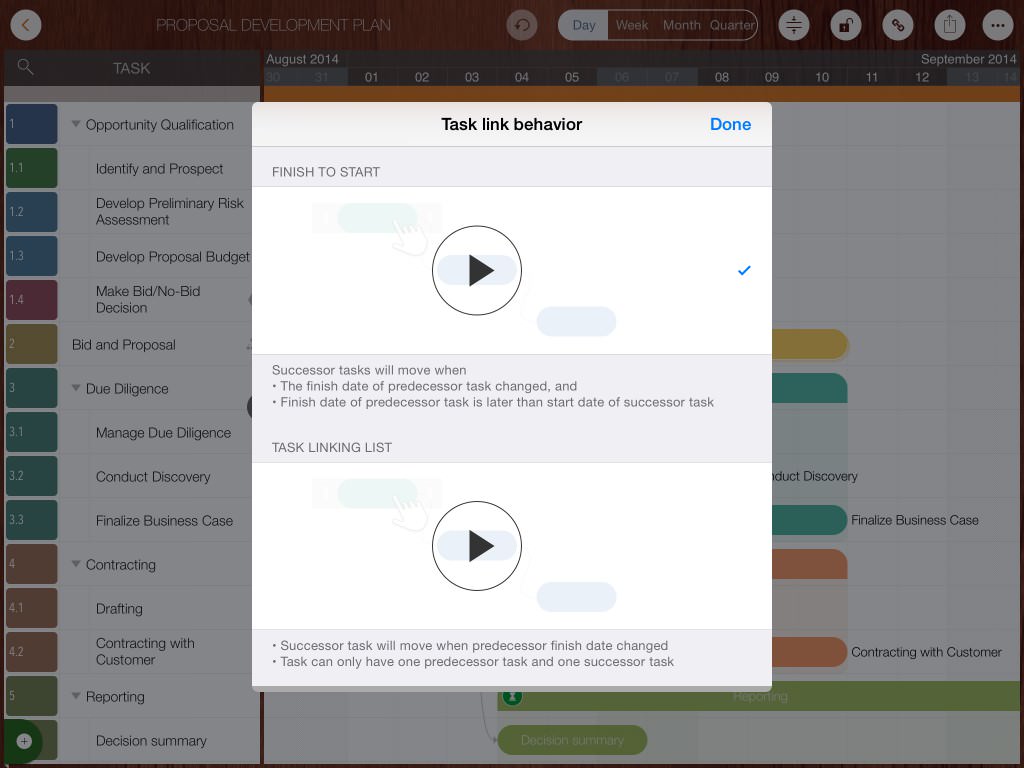
Task links are constraints that control how linked tasks shift when a task's date is changed. QuickPlan supports two link types.
Please note the differences in how successors are moved.
-
Finish to Start: The traditional "Finish to Start" link ensures the predecessor's finish date is not later than the successor's start date.

- When moving a predecessor, if its end date becomes later than the successor's start date, the successor moves to maintain the constraint.
- Moving a successor does not affect the predecessor. Task links are typically used for rescheduling during execution; completed tasks (predecessors) should remain unchanged.
- One task can link to multiple predecessors and successors.
-
Simple Link: Tasks are tightly linked; moving one task in a chain moves all other linked tasks simultaneously.

- Sucessors move simultaneously with the predecessor.
- Moving a successor does not affect the predecessor. Task links are typically used for rescheduling during execution; completed tasks (predecessors) should remain unchanged.
- One task can link to multiple predecessors and successors.
- We developed this feature based on user feedback. This link type feels more natural than traditional ones, though it is not standard in other planning apps.
Configure Project Task Link Behaviour
-
Tap the project name on the toolbar in an open project view to edit project properties, including link behavior.

-
Tap to change the option.
Best Practice
Mathematical constraints are precise, but are they practical for large numbers of links? Read our article on how to organize tasks effectively.
Projects Maintenance
Project Properties
Task Maintenance
Gestures & Keyboard Shortcuts
Customization
Synchronization
Team Collaboration
Project Sharing
- Sharing Project from iPad
- Import Project on iPad
- Sharing Project from iPhone
- Import Project on iPhone
- Sharing Project via AirDrop
- Sharing Project via Email
- Sharing Project via Dropbox
- Sharing Project via Google Drive
- Sharing Project via OneDrive
- Sharing Project via Box Cloud
- Sharing Project via 3rd Apps
Integrations
Others